
Europe’s Next Data Center Hub Is on the Spanish Ballot

Aleksandr Crusellas - Opinion Editorial
With the announcement of the imminent November 29 Spanish elections, the next government will play a major role in deciding whether the country becomes Europe's data center hub. Global demand for computing power is rising, driven largely by artificial intelligence (AI), and Spain is competing to host the data centers behind it. Electricity use from cloud computing is expected to grow by more than 50% in Europe by 2030. The continent's established hubs, which the industry has called "safe havens", are running out of grid capacity (the room left on the power network to connect new users), while Spain offers some of the most affordable power in Europe. The data center decree remains a draft, and the 2030 grid plan is still awaiting final approval. Spain has the low-cost renewable power to become Europe's data center hub, but its grid and its draft regulation currently limit that potential. Whoever wins on November 29 must finish the grid plan and ease the decree’s renewable rule, or Spain’s price advantage will push investment to its neighbors.

Image 1: Rosenow, J. (2026). Spain's electricity is among Europe's cheapest.
Spain has been considered by investors as one of the most attractive locations on the continent to expand capacity. In Frankfurt and London, grid capacity is no longer available, and companies may wait a decade or more for a connection. Spain's wholesale electricity averaged €44 per megawatt-hour (MWh) in the first four months of 2026. That is competitive for the European market, with German electricity being twice as expensive. Large capacity alongside low price makes Spanish power the preferred source in Western Europe. The response is clear, as Amazon alone has raised its planned investment in Spain to €33.7 billion. In parallel, the EU's proposed Cloud and AI Development Act aims to triple, at least, the Union's data center capacity within the next five to seven years. Currently, US companies dominate around 70% of the European cloud market. Therefore, Spain's appeal complements its structural advantage with the political security of being an EU member. Wind and solar have pushed gas out of price-setting, keeping electricity prices down while other countries face grid limits. This aligns with the EU's goal of expanding regional capacity, suggesting that Spain could become a central location for European computing. However, a low market price does not guarantee a grid connection. As attractive as Spain’s potential is, it remains constrained by a grid that cannot connect every planned project.

Image 2: Rosenow, J. (2026). Gas less often setting Spain's power price.
Spain currently presents an incomplete regulatory framework for connecting data centers to the grid, which has limited new capacity so far and might continue to do so. The draft decree would make grid access conditional on the company running the data center being established in the EU and keeping its operational data within EU territory. It would also require at least 80% of each facility's consumption to come from renewable generation, matched hour by hour. The industry association SpainDC, however, warns that it could put 80% to 90% of new investment at risk. The draft 2030 grid plan reserves 3.8 gigawatts (GW) for data centers and gives priority to industrial projects. Data centers already hold 34.2% of the connection capacity granted on Spain's high-voltage grid (6,328 megawatts), yet none of these projects is operating. Box2bit moved its campus from Cariñena to Épila after being left without grid access in the new state plan. These rules reflect the government’s aim to make data center growth conditional on new renewable generation, so that other consumers do not bear the cost. The price of that choice is considerable uncertainty for investors. Since neither the decree nor the grid plan has been finalized, these crucial decisions are likely to fall to the next government.
The November 29 election will decide the new rules, tightening or loosening the legal constraints surrounding data centers. Three parties matter most: the governing Socialists (PSOE, center-left), who drafted the decree; the People's Party (PP, center-right); and the far-right Vox. Current polls suggest that a right-wing majority is the most likely outcome. Surveys published in October give the PP and Vox between 186 and 212 seats combined, well above the 176 needed for a majority. Fourteen private polling firms place the PP first, but none gives it more than 150 seats, meaning the PP would most likely depend on Vox. The state pollster (CIS) continues to place the PSOE ahead. In 2023, polls overestimated the PP, which won, but without the expected lead or an absolute majority. Regarding the PP, its president, Alberto Núñez Feijóo, has promised to keep Almaraz open beyond 2030 and has called for the nuclear closure calendar to be canceled. Vox seeks to halt large wind and solar projects in Aragón and to build a nuclear plant instead. It already holds Aragón's environment and agriculture portfolios in its coalition with the PP. This presents three plausible outcomes: a PP-Vox government that keeps the renewable requirement, one that scraps it, or a PSOE status quo. A PP-Vox government would probably keep existing nuclear plants open for longer, which would preserve stable supply but add no new capacity for projects due before 2030. If it kept the current renewable requirement, its partner's opposition to new wind and solar would be difficult to reconcile, unless it is negotiated away. If it removed the requirement, it would face the higher gas use and electricity costs that the decree was designed to prevent. On the other hand, a result favoring the PSOE would likely preserve the status quo of volatility and uncertainty as it adds regulations to the market.
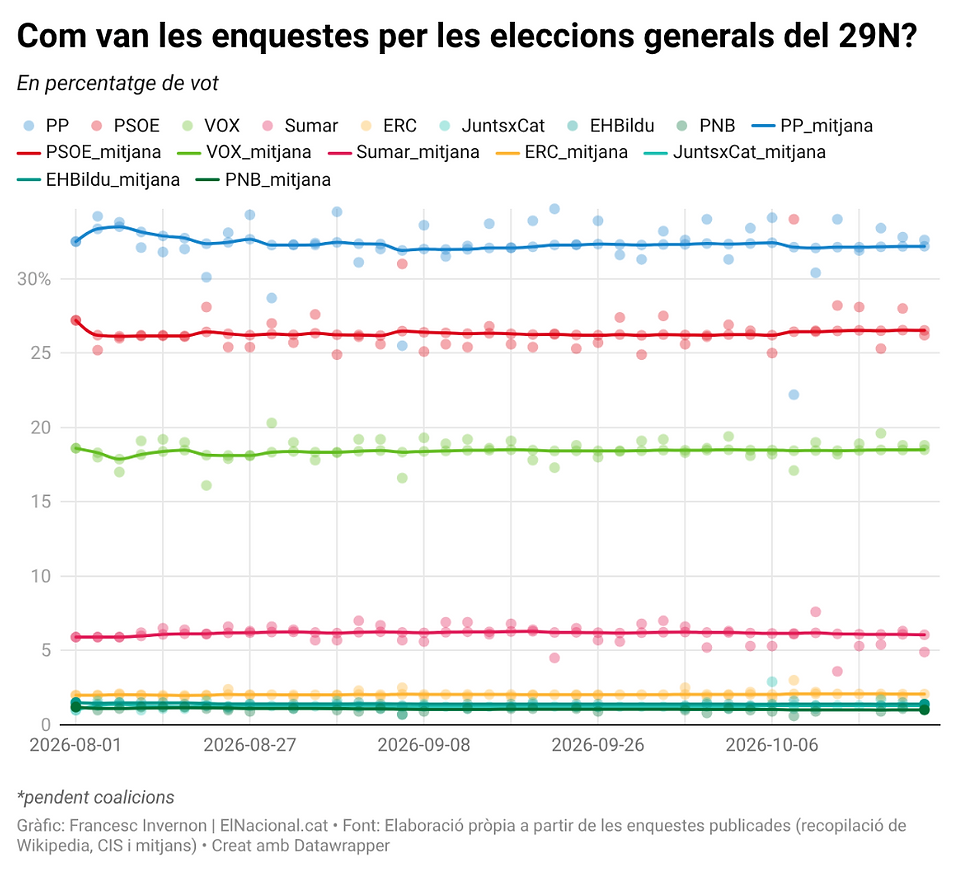
Image 3: Invernon, F. (2026). Com van les enquestes per les eleccions generals del 29N? [How are the polls for the November 29 general election going?] [Chart].
Beyond Spain's market, the result will also shape where Europe's new data center capacity is built, and what role each state plays. If a PP-Vox government softened the decree, Spain would be well placed to meet European demand, as capacity is already moving away from the traditional markets. Much of that growth would come from US companies such as Amazon and Microsoft, which are behind the largest projects announced in Aragón. Under the current draft, Spain would regulate data residency (where data must be physically stored) even more tightly than EU law requires, possibly deterring the American companies behind much of its recent capacity. Neighboring markets are ready to take that demand, with Microsoft investing €8.6 billion in Sines, Portugal, more than it has already invested in Spanish data centers. Spain's power links with France can carry only about 3% of its generating capacity, far below the EU's 15% target for 2030. Hosting data centers is one of the few ways Spain can turn its inexpensive power into value for the rest of Europe, as little of it can be exported directly through the grid. A PP-Vox government would make Spain the main alternative for companies priced out of the northern hubs. This would help the EU approach its goal faster, but largely through US-owned capacity. In turn, it could sit uneasily with Brussels' push for a sovereign cloud (computing services owned and controlled within Europe). This conflict of interests brings forth uncertainty in the industry. On one hand, the EU could divert its investment into other regional power suppliers. On the other hand, it could resort to limiting the magnitude of US cash inflows into Europe. Either way, the data center industry is at risk of supranational regulatory pressure. Otherwise, the PSOE government would keep Spain closer to that sovereignty agenda, but growth would be slower. The election’s result will compromise European computing power as a whole. The other main providers, such as Germany and the Netherlands, are currently running low on capacity. In turn, the scale of global investment in Spain will limit how much funding is left for other European nations.
In conclusion, Spain's low power prices certainly make it an attractive prospect for growth. Nonetheless, the grid and regulatory bottleneck will ultimately dictate the final capital invested. While a PSOE victory would keep data center growth slow, a PP-Vox coalition would not automatically remove all the legal constraints, given the partners' contradictory renewable energy policies. Whatever the result, the decision will help determine whether the EU can at least triple its data center capacity. The data center industry positions itself as high-risk, high-reward. Two of the three plausible outcomes would harm its profitability and increase uncertainty, but the upside from favorable legislation could pave the way for a European data powerhouse.
Comments